Tag Archives: weapons

Killer Asteroids, and What We Might Do About Them

These are notes from a presentation by Henry Spencer at Capricon 46. Any mistakes here are mine, not Henry’s. I have amplified my notes with web links for further clarification. Here is the blurb from the convention program:

Near-Earth asteroids (and their cousins, comets) are interesting objects, possible future sources of metals and other materials… and potential threats to civilization and even life on Earth. The good news is, this is the only type of major natural disaster that we might actually be able to prevent. A look at what we know about asteroids (and comets), what sort of threat they present, and what we can do to anticipate trouble from them and maybe head it off.

Continue reading

Atomic Bombs 101

These are notes from a presentation by Henry Spencer at Capricon 46. Any mistakes here are mine, not Henry’s. I have amplified my notes with web links for further clarification. Here is the blurb from the convention program:

The real history and technology (so far as they’re publicly known) of nuclear weapons, and the ways SF gets them wrong — aimed at authors, techies, and interested readers.

Continue reading

World War I at Sea: 1914

I recently read Robert K. Massie’s, Castles of Steel: Britain, Germany, and the Winning of the Great War at Sea

Some of this story I knew from other books, notably Dan Van der Vat’s The Ship that Changed the World: The Escape of the Goeben to the Dardanelles in 1914. In the 1920s Winston Churchill wrote that the Goeben brought “more slaughter, more misery, and more ruin than has ever before been borne within the compass of a ship.” This was because the Goeben forced the Ottoman Empire into World War I on the German side. This in turn led to the breakup of the Ottoman Empires. Long after Churchill wrote those words we are still dealing with the consequences of that: Modern Syria, Iraq, Jordan, Lebanon, and Israel were all Ottoman provinces in 1914.

Continue reading

Steel Lobsters

Notes and quotes concerning Myke Cole, Steel Lobsters: Crown, Commonwealth, and the Last Knights in England

“The total time from the moment they donned their armor , to the battle that would see them pass into legend, was about a month. It was a bright, final flash of glory – like the sparkling sun on their polished metal armor – before winking out forever.”

Continue reading

Made a knife

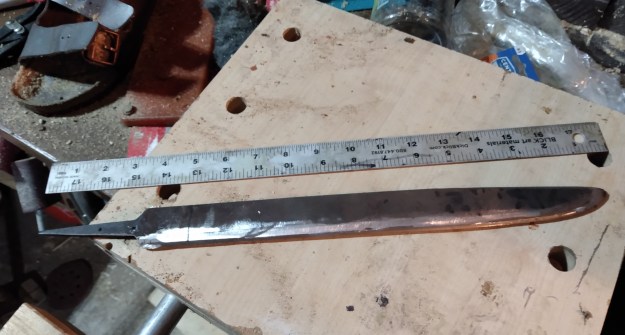
Years ago I started making a knife from a file. I put the project aside, but when Mia and I started watching Forged in Fire earlier this year I was inspired to pick it up again.


knife as ground

Knife as of Dec. 1 2021. File initially ground into knife. Started from an 18″ file. Prior to December 2021 I had ground it into this shape.
Continue reading

Greek and Roman sling messages

From Writing funny stuff on ammo is over 2000 years old:

Know those great photos of World War II crews painting bombs with messages like “Easter Eggs for Hitler” or “To Mussolini, with Love”? It turns out, your ancestors have been doing that for over 2,000 years, because the British Museum has sling shot from 300 B.C. where missileers were telling the enemy to “Catch!” their shot.

The British Museum has a good example.

“Catch” is one of the tamer examples. From Humorous Inscriptions on Lead Sling-Bolts (Sling Bullets; Slingshot) Reflect a Roman War of Words:

Some NSFW examples follow

Science Fiction got there first (again)

Back in High School (1964-68) I read a lot of science fiction by Mack Reynolds. His Joe Mauser series is set in a world where the cold war continues into the 21st century, but, to avoid catastrophe, the West and the “Sov-world” have agreed to restrict all military forces to pre-1900 technology. There is still lots of fighting going on at that level.

Recently I was reading about the decades old border dispute between between China and India countries, which actually led to war in 1962. The conflict still simmers on, but a 1996 agreement states that

Neither side shall open fire, cause bio-degradation, use hazardous chemicals, conduct blast operations or hunt with guns or explosives within two kilometers from the line of actual control.

Neither side wants to get the blame for starting a shooting war, so both sides are following the letter of the agreement. However, nobody is backing down. There have been reports that “Chinese troops have used improvised edged weapons, such as nail-studded clubs, in … skirmishes with Indian forces.” and both sides have martial artists in their border forces.

It seems that the Chinese are escalating. We now have Chinese soldiers armed with new devices for hand-to-hand combat with Indians in Tibet. Actually the “new device”, the guan dao, is quite old. It similar to a a western medieval halberd. It will be interesting to see how Indian army responds. They have a rich tradition of edged weapons to draw upon.
American Poison Gas in World War II

During World War II the United States was prepared to use poison gas against the German army. 100 tons of mustard gas were shipped to the port of Bari in southern Italy, held by the Allies and far behind the front lines, on the ammunition ship John Harvey. Being an ammunition ship, the John Harvey also carried a full load of conventional explosive munitions. Disaster At Bari tells the story of how, on the night of December 2, 1943, the port of Bari was attacked by 105 Ju 88 Luftwaffe bombers. The attackers achieved complete surprise: the Allied high command did not think the Luftwaffe was still capable of a raid this far behind the front lines. The lights were on in the harbor so that unloading the docked ships could continue during the night. The Luftwaffe pilots and bombardiers made good use of this, and sank 17 cargo and transport ships, with 8 others damaged. One of the targets was the John Harvey. As an ammunition ship it blew up in a huge explosion, spreading mustard gas all around.

Hundreds of victims were taken to hospitals with strange symptoms. Many died and the medical staff had no idea why. The presence of mustard gas on the John Harvey was a closely guarded secret. Eventually a senior medical officer was flown in from Allied headquarters in Algiers. He quickly realized that the men had been exposed to mustard gas. With some difficulty, he was able find out that the John Harvey had mustard gas in its cargo. There 617 military and merchant marine mustard-gas casualities that night. 84 men died. No one knows about the casualties among the Italian civilians. Many lives could have been saved if the presence of mustard gas had been known immediately and proper treatment administered to the victims.